
Short answer
A leadlist in Estonia is built in four moves: describe the buyer in measurable terms, turn that description into filters, remove the companies that should not be there, and only then look for the right person. Most weak lists skip the first move and try to fix the result afterwards.
Step 1: describe the buyer in facts, not adjectives
"Growing tech companies" cannot be filtered. "Active private limited companies in Harju county, software development as main activity, 10 to 50 employees, turnover up year on year" can. Write the profile as things a register knows:
- Where: county, city or municipality.
- What they do: the EMTAK activity code, at the level that matches your offer.
- How big: employee range and turnover range.
- What stage: registration date, legal form and status.
- What is happening: growth, exports, investments, a new board member.
Step 2: turn the profile into filters
Start with the two filters that remove the most: location and industry. Then add size. Look at the count after each step. If one filter cuts the list from 4,000 to 30, it is doing most of the work and deserves a second look: is it too strict, or is it exactly the point?
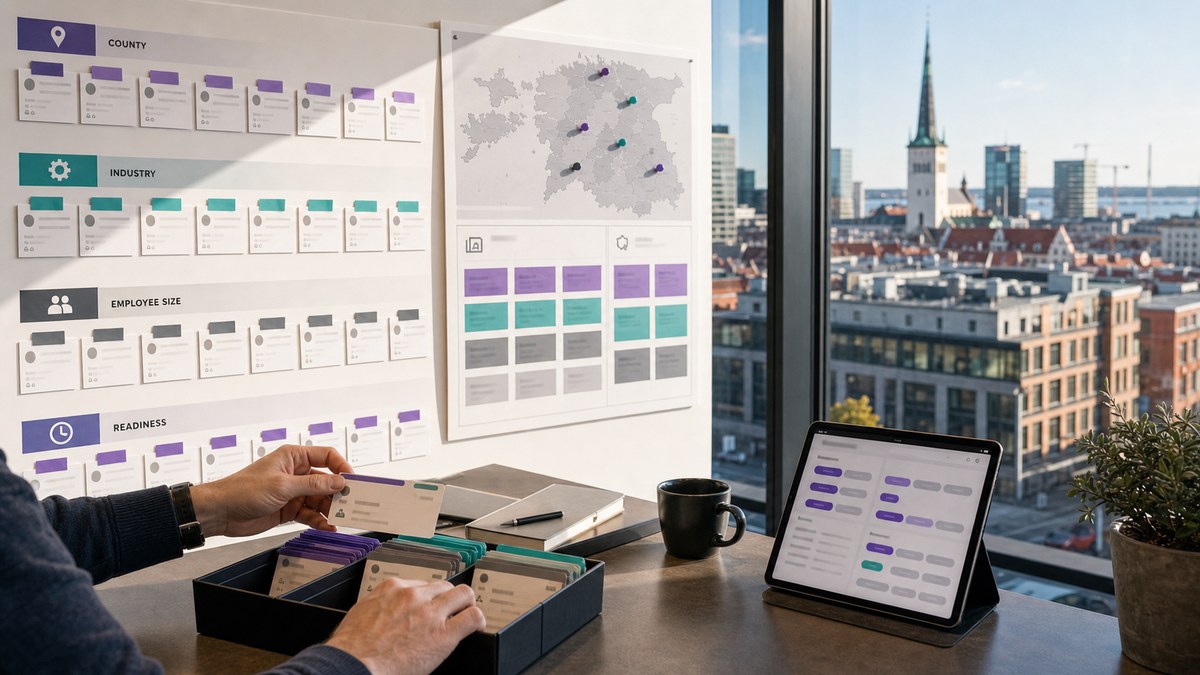
In the leadlist builder the filters are grouped the same way: location, industry, company profile and people signals, plus financials, exports, investments and expansion for companies where that information exists.
Step 3: remove what should not be there
Every list needs a cleaning pass before anyone is contacted:
- Companies that are deleted, in liquidation or in bankruptcy.
- Companies with no employees and no turnover, unless you sell to founders.
- Existing customers and anyone who has opted out.
- Several entities of one group, if one conversation covers them all.
Step 4: find the right person
Only now does the question of who to contact matter. In a company of five, the board member is the buyer. In a company of two hundred, the board member signs but someone else chooses. Board members are public in the Business Register; role-specific contacts take more work, and should be business contacts.
A worked example
An accounting firm in Tartu wants new clients. Profile: active companies in Tartu county, registered in the last 12 months, any activity except holding companies, with at least one employee. That is a list of new businesses that have just started paying salaries and need bookkeeping now. The message writes itself, because the reason to call is the same for every row.
Common mistakes
The first is starting from a keyword instead of a profile, which gives a list that looks relevant and is not. The second is cleaning after sending, when the damage to sender reputation is already done. The third is building one large list for several offers. Two lists of 150 beat one list of 300, because each can carry its own message.
Next step
Open the leadlist builder, set location and industry first, and watch how the count changes. If your buyer cannot be described by filters at all, Market Scout builds the list by research instead.
FAQ
What is a leadlist?
A leadlist is a list of companies, and often the right people in them, chosen because they match a defined buyer profile. A good one is narrow enough that one message is relevant to every row.
Where does Estonian company data come from?
Mostly from public sources: the Business Register for legal facts, board members and annual reports, and the Tax and Customs Board for VAT status, tax debt, turnover and employee figures.
How many companies should a first leadlist have?
Fewer than most teams expect. A list of 100 to 300 well-matched companies usually teaches you more than 5,000 loosely matched ones, because you can tell from the replies whether the segment is right.
Can I email everyone on the list?
Not automatically. Check that the contact is a business contact, that your message is relevant to the company, and that every message has a working opt-out. This is not legal advice; confirm the rules for your own case.